Showing posts with label second look. Show all posts

Monday, July 26, 2010

Inception: A Second Look

**Spoilers Contained

This film has more heart and soul than anyone is giving it credit and I deserve part of the blame for that. The general critical narrative for Inception has been that it's a film that features boundless creativity, a great imagination, and a pulse pounding plot; but sadly lacks the emotion to truly involve your heart along with your mind. Upon a second viewing of the film, I think we've got it all wrong. Inception is a film that beams with humanity and features a simultaneous affront and encouragement to its viewer.

In fairness, I think that Christopher Nolan is partly to blame for such a misinterpretation of his own work. The truth is, there is just too much going on within this film to be fully experienced in just one viewing. I'm not saying that it's too complicated, but perhaps too dense to reward a viewer it's fullness with just a single screening; at least it was for me. While I'm still in awe of the ideas at play and the visuals put on screen, my second viewing was more a revelation of themes and heart. Don't get me wrong, I wasn't fighting back tears, but I was touched by several themes that spoke to me in ways I hadn't thought about in my first viewing. It has helped me to reconsider the film, and I hope that you consider them as well. Let me explain.

For me, the film's central dramatic struggle was to keep hold of reality. For the most part, this means that our characters want to know if they are in the real world or are in a dreaming state. Although it also stands in for the central idea of inception; are these my real thoughts after all? It provides for great tension in the film, as it's a nagging problem for Cobb (Leonardo DiCaprio) as we see him constantly spinning his top to remind himself of reality.
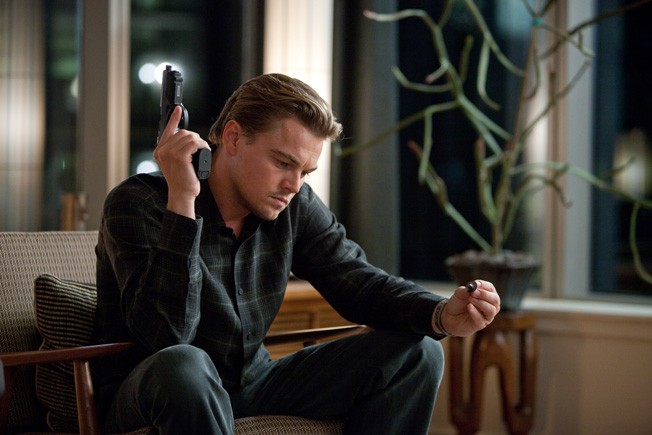
Interestingly, there are two people in the film who truly do lose sight of what 'reality' is; Cobb's wife Mal and a group of 'shared dreamers' in a Mombasa backroom. In the case of Mal, Cobb informs us that, "...she locked away a secret, deep inside herself, something she once knew to be true... but chose to forget." In this case, she locked away and forgot her totem (the same top that Cobb uses), symbolizing that she has chosen to lose track of reality; accepting the dream world as her new reality. In the Mombasa backroom, we are told that this group of 'shared dreamers' meets everyday for several hours of dreaming (equaling many more hours in the dream world). The overseer then states, "They come to be woken up. The dream is their reality now. Who are you to say otherwise?"

Upon first watch, I felt the Mombasa scene was more or less a throw away sequence intended to show how some have become addicted to the dreaming. In retrospect, it provides a sharp contrast and a strong argument against what would become the major theme of the film. With all that 'shared dreaming' has to offer; the extended lifetime, the creativity, and the experiences; it's not reality and therefore inferior, a shade of our real world.

In Cobb's final confrontation with his wife Mal he must confront the decision of spending a practical eternity with her in their own world ("I miss you more than I can bear, but we had our time together. I have to let you go") and desiring to return to the real world and see his children*. Ultimately, Cobb declares to Mal, "Look at you. You're just a shade, a shade of my real wife. How could I capture all your beauty, your complexity, your perfection, your imperfection, in a dream? Yes, you're the best that I can do. But, I'm sorry, you're just not good enough."

I particularly like this idea that we deserve better than our dreams, we deserve reality. Risk, adventure, loss, tragedy, grief and imperfection are central to the human experience and isn't worth losing even if it means gaining immortality or 'togetherness'. While enlightening, it's not exactly a groundbreaking insight into life and one could possible even argue (as Mal and the Mombasa shared dreamers do) that Cobb is wrong and reality isn't all its cracked up to be. This is where I think the film really shines in that Cobb comes to this insight and conclusion honestly and naturally. It is faith that is required in order to understand Cobb's arrival to truth. This is where Nolan's humanity shines through and the cold precision is put to bed.

When Saito offers Cobb the possibility of clearing his name in return for inception, Cobb asks what assurances Saito could give. The reply is "none" that he would have to take him on good faith. Saito offers, "Dare you take a leap of faith? Or become an old man, filled with regret, waiting to die alone." Cobb decides to take the job, hoping the reality of seeing his children again would be better than becoming old and filled with regret. Similarly, when Cobb and Saito (now an old man) both meet again in limbo, a remarkable exchange takes place,

Saito: You remind me of someone... a man I met in a half-remembered dream. He was possessed of some radical notions.

Cobb: I came here to tell you... something.
[pause]
Cobb: Something that... you once knew to be true.
Saito: [remembering] Impossible...

Cobb and Saito have a vague remembrance that their current world is not reality, that reality was awaiting them, but they would both be required to die for it. There are clues, evidence (the spinning top, vague remembrances) and doubts about what is real and not (and ultimately the film still leaves room for doubt), but it will require faith in order for them to meet reality. It's not a math problem or a scientific experiment, but a journey.

While I think this is a correct interpretation of Inception's central theme, it has reverberated with me so strongly because of its ability to speak to my religious beliefs. As a Christian I believe that there are clues and evidence within our world that points to a creator God and an entire spiritual realm of reality. However, there are still doubts (Man is there doubts!) This isn't a math problem or science experiment, but a journey; one that requires faith. Incredibly, like Cobb and Saito who must give up their world of limbo, (where they have full power and control) and literally die; Christ says that we must also give up our world of power and control and die to ourselves in order find the real truth of our world. I find this incredibly enriching.

Am I saying that Inception is a Christian film? Certainly not. Both seek to speak to the truths of our existence, and in that way they are indeed similar. The film's acknowledgment that there are not only clues to ultimate reality, but also doubt about our reality, makes it surprisingly relatable (especially in our postmodern context). Even more so, the films embracement of the necessity of faith in order to experience the realities of life, makes it thoroughly human. In that sense, I think it speaks not just to Christians, but to anyone who has experienced life. Appropriately there is room to doubt for those who look for it (does that top keep spinning?), but Cobb's and Inception's embracement of the real and rejection of the dream (making it very Matrix-esque), symbolized by Cobb's journey to his children, is a full on emotion and humanity.

In fact, taken to its conclusion, the film almost insults the viewer. Like the shared dreamers of Mombasa, we viewers connect and share this dream with Nolan, projecting our own subconscious into the film. In our ever increasing media society where we consume films, television shows, and video games for hours a day, are we not like those living their lives away in a dream world? To that, the film's exhortation to reject the dream and embrace the fullness that reality has to offer is both an affront and an encouragement to its viewer. Of course it's the best type of affront, a warning and a clarion call, that reality waits beyond the doors of the theatre. This to me is the humanity of the film, and it comprises the true contribution that Inception has to offer.


*This also rings true with Cobb's notion that positive emotion always seems to trump negative emotion. Ultimately, the positive emotion of reuniting with his real children has trumped the negative emotion of the guilt he feels for conceiving the idea that would lead to Mal's death.

Tuesday, January 5, 2010

Avatar - A Second Look

Because I am young and I have plenty of time and money to just throw away, I decided to drop the cash, don the glasses and view Avatar a second time. There is some big dumb part of me that desires to give films a second chance and with all of the financial and critical success that Avatar is recieving, I thought it would be worth it to give myself a second viewing a few weeks after my initial endeavor.

I've done this project a few times in the past, most notably with Pirates of the Caribbean: Curse of the Black Pearl (I fell asleep both times in it), Iron Man, and Star Trek, and unfortunately a second viewing just confirmed my initial feelings. However, I recently re-viewed State of Play on DVD and was surprised by just how much I loved it. It changed my opinion so much that it was bumped from a 'B' to an 'A-'. It put me in a charitable mood and I decided to extend my newfound grace and mercy to a film that was quickly becoming one of the more overrated films in pop culture. Below are my thoughts after the second viewing including some comments on things that I didn't get to in my first review, which can be found here

- All of my original thoughts on the storyline and character motivations were confirmed and deepened. Jake's motivations for switching sides and joining the Na'vi are simply too selfish. They are not explicitly selfish, but it's clear he enjoys this better body, the natural lifestyle, the new girlfriend, the rites of passage, flying through the air; and it overpowers any message about helping the Na'vi because it's the right thing to do. Instead of, "What your doing is wrong and their lives are sacred", it becomes, "What your doing is wrong, these people and there way of life are awesome!"


- It doesn't help that he Na'vi are simply too noble and too innocent over and against the greedy imperialistic American mercenaries. Jakes' Na'vi experience is spared all the normal trappings that come with overtly theocratic societies. The rituals (the chanting and convulsing circle) that in any other film would be looked upon as naive and dumb, are looked upon as cultural and in tune with nature in this film. The native religion they espouse would be laughed off the screen in most any other film, but is given a noble reality and scientific support.

- Jake is attacked by a pack of wild dog like animals who will literally kill him, a giant flying bird that attempts to kill him, yet there Jake accepts a reverence for nature because he ends up not getting hurt. I'd like to see how nature appealed to Jake if one of the beasts took his Avatar legs, then we'd see how well he warmed up to the new worldview.

- Sam Worthington is terrible for me as the lead here; he's neither a bad actor, nor a good actor, he just is. He's about the most bland lead character I can think of in a successful science fiction or fantasy picture. I honestly don't care for him, don't care for his character arc, and don't care much that he becomes a warrior by the end. Nothing attached to him works for me. It doesn't help me that he's made to mumble through tons of voice-over, barely registering much emotion other than, 'blah'. For whatever people thought of DiCaprio in Titanic, he was at least charismatic.

- Jake Sully's taming of his flying 'dragon' (I don't know what to call it), really is the best sequence of the film and is quite possibly one of the best sequences in all of 2009. It's the best example of all the positives of the film in one place. The visuals are at their most astonishing, the depth of 3-D is at it's greatest, and it's an experience that no one has ever really seen before on film. The music, sound design, film composition, pacing, writing, work perfectly to present a pretty darn riveting and captivating sequence.


- More impressed this go round with the 3-D and the special effects. While I enjoyed them both more and think that some sequences truly reach the 'photo realistic' stage, do people really think this is a 'revolutionary' step forward? Did they forget Return of the King, the Star Wars prequels (whose landscapes are just a step down from this), or even Davey Jones of Pirates of the Caribbean?

- The sound design is quite spectacular for this film. Nailed me to my seat a couple of times (especially the fall of hometree) and was exemplary in the taming your dragon sequence reference above. The score works and works very well, but certain musical cues reminded me of Titanic, I don't know why Horner or Cameron would allow those similarities.

- I really don't get the whole ground army strike in the last battle sequence. They don't explain too well where they drop off and exactly why they need a ground force to begin with. Why exactly have a large ground force right in the vicinity of the area your dropping a motherload of bombs? If anything, the army drew out the ground forces of the Na'vi away from where the bombs would strike. The claustrophobia of the jungle also gives the entire sequence a 'could be anywhere' feel and notches down the epic nature of the film in general.


- The final aerial battle was much better than I gave it credit for. Beautiful to watch, and filled with some good brutal action beats. I do wish it was held for a bit longer and included some more characters I cared about.

- The political commentary bugged me a bit more the second time around as it was a bit more blunt and apparent (and moronic) than the first time I saw it.

- I found myself bothered a bit more by the appearance of the Avatars than the first viewing. The faces of Jake, Grace and the other nerdy Avatar feel a bit cartoonish (since we see their human likeness as well), especially against the 'photo realistic' backdrops.


- 'I See You' is Cameron's attempt at a second 'Don't Let Go' catchphrase. It's worse, much worse, and it makes me cringe each time they say it.

- Overall, I would say I found myself more wrapped up in the film than the first viewing. That's good and bad for the film. The good points (visuals, 3-D, and action) were better this time out, and the weak points (story, characters, motivations, subtext) were more aggravating this time out.

- I honestly wonder what will be remembered about this film in the future. I don't think people will remember Jake or his girlfriend, or the villain either. I don't think people will dress as the Na'vi or desire to be one of the mercenary grunts. I honestly think the thing what will stick the most is the dragon flying and the visuals of Pandora. In other words, it will be special effects. I have no axe to grind so I have no stake in what Avatar's lasting impact on culture will be, but I honestly think that despite the big box office take, and several attempts to define Avatar as a movie that stands as a story more than f/x, this one just won't be remembered as a great story. Who knows, I could be wrong. Maybe that will require a third endeavor into the cinema.