Showing posts with label Christopher Nolan. Show all posts

Monday, July 26, 2010

Inception: A Second Look

**Spoilers Contained

This film has more heart and soul than anyone is giving it credit and I deserve part of the blame for that. The general critical narrative for Inception has been that it's a film that features boundless creativity, a great imagination, and a pulse pounding plot; but sadly lacks the emotion to truly involve your heart along with your mind. Upon a second viewing of the film, I think we've got it all wrong. Inception is a film that beams with humanity and features a simultaneous affront and encouragement to its viewer.

In fairness, I think that Christopher Nolan is partly to blame for such a misinterpretation of his own work. The truth is, there is just too much going on within this film to be fully experienced in just one viewing. I'm not saying that it's too complicated, but perhaps too dense to reward a viewer it's fullness with just a single screening; at least it was for me. While I'm still in awe of the ideas at play and the visuals put on screen, my second viewing was more a revelation of themes and heart. Don't get me wrong, I wasn't fighting back tears, but I was touched by several themes that spoke to me in ways I hadn't thought about in my first viewing. It has helped me to reconsider the film, and I hope that you consider them as well. Let me explain.

For me, the film's central dramatic struggle was to keep hold of reality. For the most part, this means that our characters want to know if they are in the real world or are in a dreaming state. Although it also stands in for the central idea of inception; are these my real thoughts after all? It provides for great tension in the film, as it's a nagging problem for Cobb (Leonardo DiCaprio) as we see him constantly spinning his top to remind himself of reality.
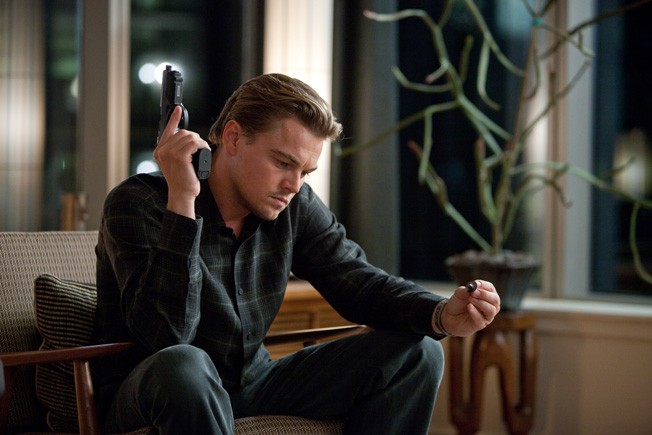
Interestingly, there are two people in the film who truly do lose sight of what 'reality' is; Cobb's wife Mal and a group of 'shared dreamers' in a Mombasa backroom. In the case of Mal, Cobb informs us that, "...she locked away a secret, deep inside herself, something she once knew to be true... but chose to forget." In this case, she locked away and forgot her totem (the same top that Cobb uses), symbolizing that she has chosen to lose track of reality; accepting the dream world as her new reality. In the Mombasa backroom, we are told that this group of 'shared dreamers' meets everyday for several hours of dreaming (equaling many more hours in the dream world). The overseer then states, "They come to be woken up. The dream is their reality now. Who are you to say otherwise?"

Upon first watch, I felt the Mombasa scene was more or less a throw away sequence intended to show how some have become addicted to the dreaming. In retrospect, it provides a sharp contrast and a strong argument against what would become the major theme of the film. With all that 'shared dreaming' has to offer; the extended lifetime, the creativity, and the experiences; it's not reality and therefore inferior, a shade of our real world.

In Cobb's final confrontation with his wife Mal he must confront the decision of spending a practical eternity with her in their own world ("I miss you more than I can bear, but we had our time together. I have to let you go") and desiring to return to the real world and see his children*. Ultimately, Cobb declares to Mal, "Look at you. You're just a shade, a shade of my real wife. How could I capture all your beauty, your complexity, your perfection, your imperfection, in a dream? Yes, you're the best that I can do. But, I'm sorry, you're just not good enough."

I particularly like this idea that we deserve better than our dreams, we deserve reality. Risk, adventure, loss, tragedy, grief and imperfection are central to the human experience and isn't worth losing even if it means gaining immortality or 'togetherness'. While enlightening, it's not exactly a groundbreaking insight into life and one could possible even argue (as Mal and the Mombasa shared dreamers do) that Cobb is wrong and reality isn't all its cracked up to be. This is where I think the film really shines in that Cobb comes to this insight and conclusion honestly and naturally. It is faith that is required in order to understand Cobb's arrival to truth. This is where Nolan's humanity shines through and the cold precision is put to bed.

When Saito offers Cobb the possibility of clearing his name in return for inception, Cobb asks what assurances Saito could give. The reply is "none" that he would have to take him on good faith. Saito offers, "Dare you take a leap of faith? Or become an old man, filled with regret, waiting to die alone." Cobb decides to take the job, hoping the reality of seeing his children again would be better than becoming old and filled with regret. Similarly, when Cobb and Saito (now an old man) both meet again in limbo, a remarkable exchange takes place,

Saito: You remind me of someone... a man I met in a half-remembered dream. He was possessed of some radical notions.

Cobb: I came here to tell you... something.
[pause]
Cobb: Something that... you once knew to be true.
Saito: [remembering] Impossible...

Cobb and Saito have a vague remembrance that their current world is not reality, that reality was awaiting them, but they would both be required to die for it. There are clues, evidence (the spinning top, vague remembrances) and doubts about what is real and not (and ultimately the film still leaves room for doubt), but it will require faith in order for them to meet reality. It's not a math problem or a scientific experiment, but a journey.

While I think this is a correct interpretation of Inception's central theme, it has reverberated with me so strongly because of its ability to speak to my religious beliefs. As a Christian I believe that there are clues and evidence within our world that points to a creator God and an entire spiritual realm of reality. However, there are still doubts (Man is there doubts!) This isn't a math problem or science experiment, but a journey; one that requires faith. Incredibly, like Cobb and Saito who must give up their world of limbo, (where they have full power and control) and literally die; Christ says that we must also give up our world of power and control and die to ourselves in order find the real truth of our world. I find this incredibly enriching.

Am I saying that Inception is a Christian film? Certainly not. Both seek to speak to the truths of our existence, and in that way they are indeed similar. The film's acknowledgment that there are not only clues to ultimate reality, but also doubt about our reality, makes it surprisingly relatable (especially in our postmodern context). Even more so, the films embracement of the necessity of faith in order to experience the realities of life, makes it thoroughly human. In that sense, I think it speaks not just to Christians, but to anyone who has experienced life. Appropriately there is room to doubt for those who look for it (does that top keep spinning?), but Cobb's and Inception's embracement of the real and rejection of the dream (making it very Matrix-esque), symbolized by Cobb's journey to his children, is a full on emotion and humanity.

In fact, taken to its conclusion, the film almost insults the viewer. Like the shared dreamers of Mombasa, we viewers connect and share this dream with Nolan, projecting our own subconscious into the film. In our ever increasing media society where we consume films, television shows, and video games for hours a day, are we not like those living their lives away in a dream world? To that, the film's exhortation to reject the dream and embrace the fullness that reality has to offer is both an affront and an encouragement to its viewer. Of course it's the best type of affront, a warning and a clarion call, that reality waits beyond the doors of the theatre. This to me is the humanity of the film, and it comprises the true contribution that Inception has to offer.


*This also rings true with Cobb's notion that positive emotion always seems to trump negative emotion. Ultimately, the positive emotion of reuniting with his real children has trumped the negative emotion of the guilt he feels for conceiving the idea that would lead to Mal's death.

Friday, July 16, 2010

Inception Review

Overall Grade: A

"We create the world of a dream. We bring a subject into that dream and they fill it with their secrets." Cobb (Leonardo DiCaprio) explains this key plot point early in the film to newcomer Ariadne (Ellen Page). It's an important description of the dream heists that Inception is based upon, but it's also a good basis for understanding how the film as a whole works, how the director/writer Christopher Nolan put it together, and even on a deeper level, how an audience interacts with a film. While Inception is about as intelligent, entertaining, and imaginative as summer blockbuster's get, its lasting contribution isn't really what someone is going to get out of it, but what someone is willing to put into it. However I think I may be getting ahead of myself here, so let me begin on the surface level.

On the surface, Inception is a marvelously written heist film with a science fiction twist. Instead of stealing money, or artwork, the idea here is to extract corporate ideas within the vault of someone's subconscious. If that sounds terribly un-cinematic, it's not. This isn't a 2 hour art-house drama between an estranged and damaged widower and her psychiatrist taking place in just one shot. Nolan, his art director, and cinematographer transform and translate what could essentially be just conceptual ideas into a true visual feast. We are talking exploding realities, cities turning in on themselves, worlds crumbling, and gravity defying fights; is that visual enough for you? Two twists take this basic plotline and begin the real story that drives Inception.


First, a corporate industrialist Saito (played superbly by Ken Watanabe) wants to hire Cobb and his team not to extract an idea from a rival CEO, but instead to implant an idea. It's a risky venture that would require Cobb and his team to go several layers into the subconscious, risking their lives in the process. Cobb is at first not willing to take the risk, until the second twist comes in, Saito offers Cobb as his reward, the chance to return to the United States and see his children. Essentially offering Cobb the vaunted one last job to make things right. Cobb takes it and sees it as his chance to "come home". Why he's exiled from the US, and why he's estranged from his wife and children are answers the film will later unfold.

These two threads (the act of inception and the emotional journey home to his wife and children) really drive the action and emotion of the entire film. From here we get to see Cobb assemble his team, hatch their plan, and then, for the last half of the film, execute the inception itself. Enough about the plot and surface level stuff, how does it all come together and work as a film?

If it seems I've focused a lot on the plot, it's because this film is packed with it. In fact, it feels at times that the film is probably a little too packed with it. The world, ideas, and storyline that Nolan has created is truly incredible, creative, and intriguing. I have no doubt that the ideas and concepts Nolan explores here will spark a slew of like-minded films within the next few years. However, the world that Nolan creates is so intricate and clever, the forward momentum of plot and action so unstoppable, that the performances and drama of the film struggle to become it's equal.

From the very get go, the film hits the ground and keeps moving from one moment, one place, one idea to the next. It's a torrid pace of storytelling that can leave some behind, but more than likely, serves to wrap one up into the film and its ultimate trajectory. This is a film that starts out running, and picks up momentum as it hurls forward and digs deeper. However, the deeper it goes intellectually, the more distant I felt emotionally.

For instance, while the audience is supposed to care deeply for Cobb's emotional 'Journey Home' and reconciliation with his children and wife, the movie never takes the time to bond us with this family. While the film revels in slowly revealing the hidden secrets behind his family, it never revels in revealing to us what was so special about 'home' to begin with. It unfortunately turns his family into one-dimensional pieces of a puzzle that slowly reveals itself and solves itself, as long as you just stick along for the ride.

It's not as if Nolan doesn't spend time focusing on these relationships, there is actually a decent amount of screen time devoted to it, it's that it just doesn't work in the way that everything else does in this movie. Incredible visuals? In spades. Seamless art direction? Check. Ominous and pounding score with accompanying sound design? Best of the summer. Clever and brutal action? Will be remembered for years. Powerful and three dimensional emotional archs? Sort of.

Perhaps though, this isn't a problem of Nolan's making. As I mentioned in the opening, our characters in the film create a dream world and then allow subjects into the dream that populate the dreams with their secrets. What's onscreen is the film and world that Nolan has created; the themes and emotion of the film reflect the vision and mind (secrets) of Nolan himself. However, in talking with a few people about the film, I found that they had a connection with Cobb's family that I didn't. As I expressed my disappointment in the emotional arch, they were surprised because they felt it worked perfectly. Perhaps, the story is a bit more complex than I've given it credit. Perhaps my disappointment and disconnection reflects less Nolan and more of me?

As I began to think along that line of thought, I find it incredibly rich that the central idea of the film (that of building a dream and allowing others to fill it) are essentially what happens when an audience interacts with a film. Each film has all the same elements of a dream world created and sustained by architects (writers), point men (directors), and forgers (actors). Like dreams, movies just begin suddenly and move from scene to scene, and when they bend reality in a way that's unreal we react accordingly. What makes this idea interesting is that the audience then becomes the subject, and we fill these films, stories, and worlds with our secrets and our projections.

** For an interesting read using this line of thought, read below the end of the review. Warning, it contains some spoilers

In this way, Nolan has left several things open to the viewer, and really allows the viewer to fill in accordingly. In this regard, the film is a smashing success and works not only as entertainment, but as a journey of adventure, interaction and catharsis. Without giving away the ending, I will say that it's most not an artistic cop out, but is seated firmly within the ideas and intentions I've mentioned above.

While it isn't a perfect film, Inception is a wonderfully crafted, and intricately plotted film that allows itself to be filled with the themes and idiosyncrasies of not only it's architect and writer, but us the viewer as well. In fact, should we not have expected as much from a film entitled "Inception"? For that reason, this film is able to rise above its few faults, rise above just being an entertaining film, and become a real piece of art. Like the best films, I think it allows each new viewer not just to enjoy it as it is, but to make it their own. Learning not just about Nolan's world and his secrets, but about our own in the process.


**Continued from above: SPOILERS

Continuing from the idea I've outlined above that this film functions in the same way that audiences interact with films. When can say this interpretation actually is manifested onscreen in the character of Saito (Ken Watanabe') as the 'Tourist'. Why does he tag along as part of the team? He say's it's to ensure that Cobb goes through with it. Essentially, I would argue that Saito is the stand-in for the audience here. The film is called "Inception". This is what we want to see Cobb and his team do, along with all the action and drama that comes with it. Saito (the audience) is the one that enrolls him in this action. In fact, isn't the idea of planting ideas into someone's mind, one of the reasons we go to the movies at all? To be inspired by ideas and to let them influence us?

Saito then comes along as 'The Tourist' as the stand-in, getting to not only watch the team in action, but also take part in the whole ordeal. In fact, our main character Cobb can't leave the film until he rescues us and brings as back into the world after the act of inception occurs. It's not until this happens that Cobb is allowed, by an act of Saito, to return and find his happy ever after. Cobb isn't allowed his happy ending, until he's accomplished what we want him to do, overcome his problems (which I would argue is the idea we want to have implanted in us), and get us out in the process.

Is it foolproof? No, but I think it's got a lot to say. Just a cursory reading of the IMDB boards shows there are several other interesting ideas and readings out there as well. This is just one that speaks quite a bit of insight to me.

Tuesday, June 16, 2009

60. The Prestige


The Prestige (2006)
Directed by Christopher Nolan

A twisty-turny (sp?) tale of dueling magicians in the late 19th century is ironic film for me. Despite its dark atmospheres, tragic twists, and cautionary tale underpinnings, The Prestige is an absolute fun time at the movies for me. I wasn't too sure about the film after my first viewing, but after repeated viewings and much thought, my enjoyment of the film has only enriched greatly.

I say it's a cautionary tale (much like Zodiac and The Descent) because it tells the tragic tale of a man consumed by his obsessions. I don't mind the fake "magic" science ending at all, and I think it actually deepens the moral of the story. It allows our characters the ability to take their obsessions to depths beyond the real realm and comments on what they could potentially be possible of. Great performances by Christian Bale, Hugh Jackman, and Rebecca Hall really top off an already great film.

The Prestige isn't a groundbreaking film, but its one of my favorite stories and it's extremely well told. Add to that, thanks to my friend (whose name I will protect here), this was the first real movie set that I have ever stepped foot on. It was a good experience and one that connects me to the film just that little bit more.